

If you’ve spent any time looking into marketing for your business, you’ve almost certainly run into the term “PPC.” Maybe an agency pitched it to you, maybe a competitor is doing it, or maybe you’ve just seen the acronym pop up enough times that you nodded along without being totally sure what it meant.
That’s completely normal. PPC is one of those topics that gets buried under jargon fast, which makes it feel more complicated than it is. So let’s strip all of that away. By the end of this guide, you’ll understand what PPC is, how it works, what the common terms mean, and whether it’s worth your money — all in plain English.
PPC, in one sentence
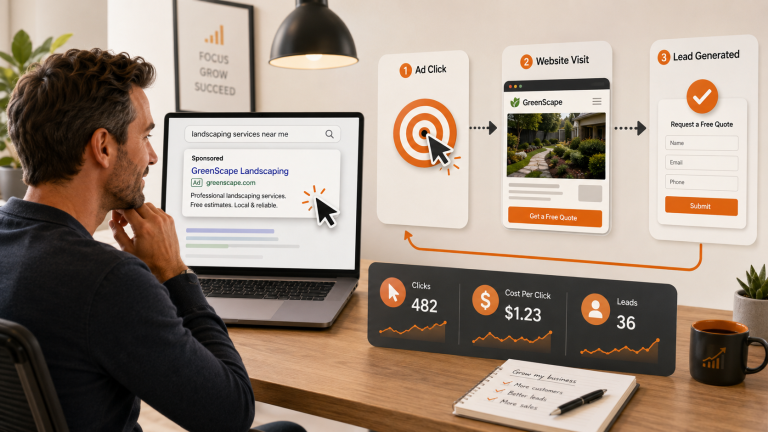
PPC stands for pay-per-click. It’s a type of online advertising where you only pay when someone actually clicks your ad.
That’s the whole idea. You don’t pay to have your ad shown. You pay when someone is interested enough to click it and land on your website. If a thousand people see your ad and nobody clicks, you owe nothing. If fifty people click, you pay for those fifty clicks.
Compare that to a billboard or a newspaper ad, where you pay a flat fee whether anyone notices it or not. With PPC, your money is tied directly to people taking an action. That’s a big part of why businesses like it.
A simple example
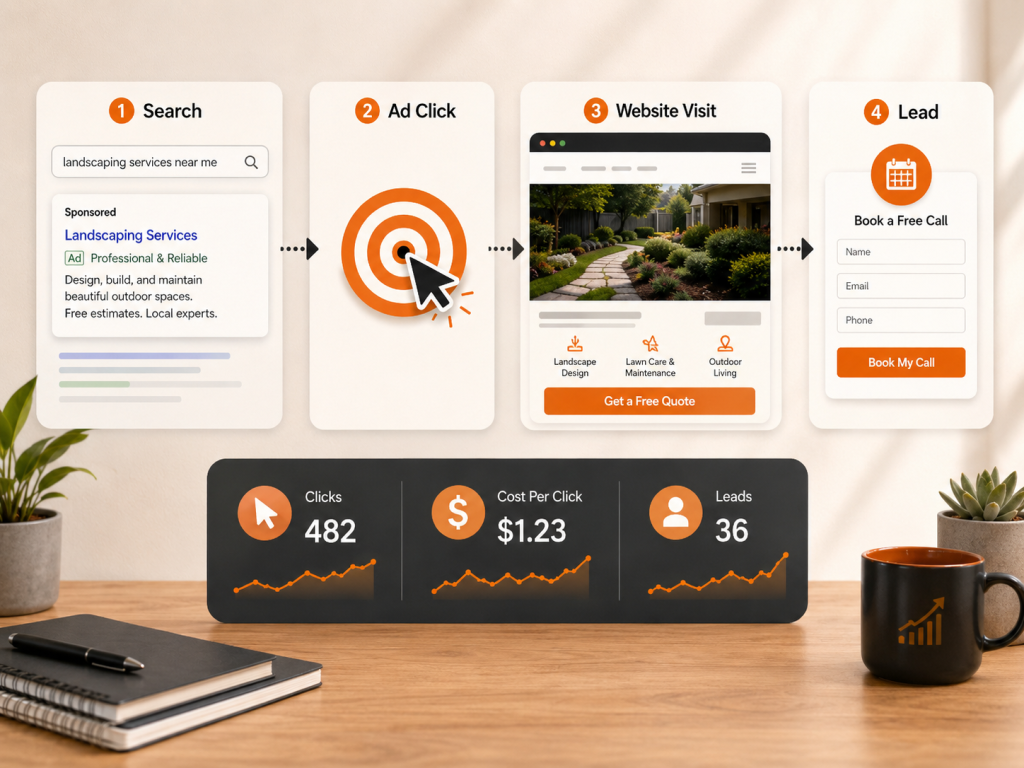
Imagine you own a plumbing company. Someone in your town has a burst pipe, grabs their phone, and searches “emergency plumber near me.”
At the top of those search results, above the regular listings, are a few ads marked “Sponsored.” If you’re running PPC, your ad could be one of them. The person clicks it, lands on your website, and calls you. You paid a small fee for that click — and you potentially just earned a customer who needed you at the exact moment they were searching.
That’s the magic of PPC: you’re putting your business in front of people right when they’re looking for what you offer.
Where PPC ads show up
When most people think of PPC, they picture Google search ads — and those are the most common. But PPC runs in several places:
- Search ads: The text ads at the top and bottom of Google (or Bing) search results.
- Social media ads: The promoted posts you see on Facebook, Instagram, LinkedIn, and similar platforms.
- Shopping ads: The product listings with images and prices that appear when you search for something to buy.
- Display ads: The banner ads that follow you around on websites and apps.
- Video ads: The ads that play before or during YouTube videos.
They look different, but they share the same basic billing idea: you’re paying for clicks (or, in some cases, for views or other actions).
How the “auction” works
Here’s the part that surprises people. You don’t just buy an ad spot outright. Instead, every time someone searches, the ad platform runs a lightning-fast auction to decide which ads show and in what order.
You tell the platform the most you’re willing to pay for a click — that’s your bid. But the highest bidder doesn’t automatically win. The platform also looks at how relevant and high-quality your ad is. Google calls this Quality Score.
Think of it this way: the platform wants to show people ads they’ll find useful, because useful ads keep people coming back. So a business with a slightly lower bid but a highly relevant ad and a good landing page can beat a competitor who bid more but offers a clunky, irrelevant experience. In practice, this means you’re often rewarded for doing things well, not just for spending the most.
It also means you usually pay less than your maximum bid — just enough to edge out the next advertiser.
The key terms, decoded
You’ll hear a handful of terms over and over. Here they are without the mystery:
- Impression: One time your ad is shown. (You don’t pay for these in PPC.)
- Click: Someone clicks your ad. (This is what you pay for.)
- CPC (cost-per-click): The average amount you pay for each click.
- CTR (click-through rate): The percentage of people who clicked after seeing your ad. A higher CTR generally means your ad is resonating.
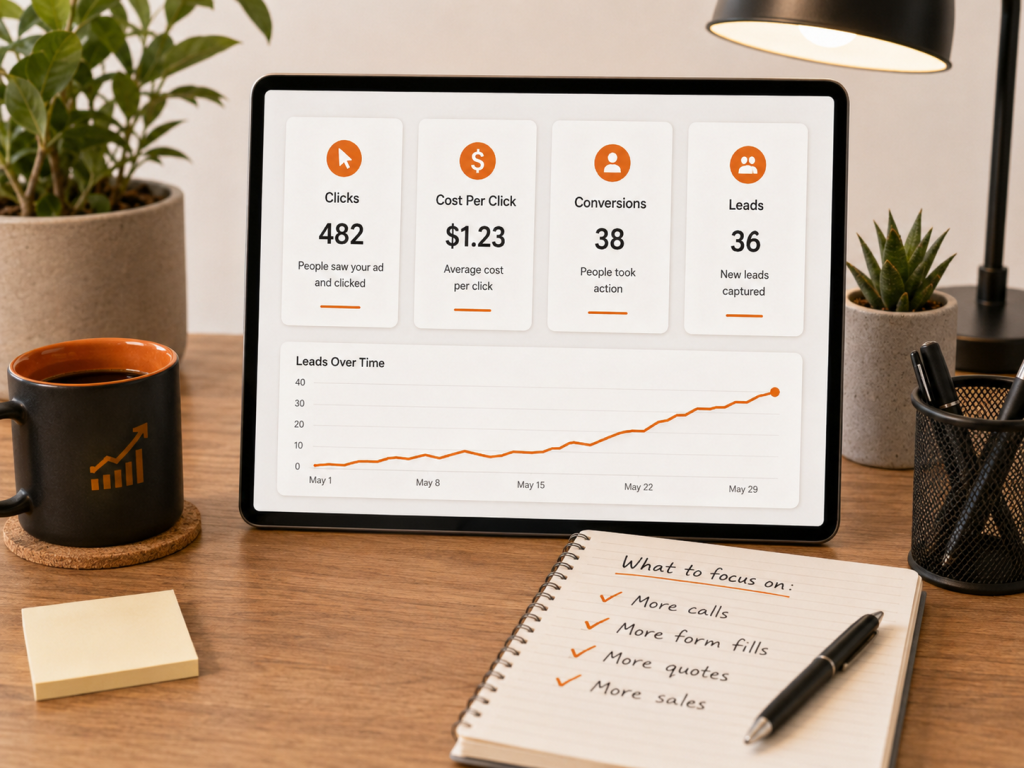
- Conversion: The action you actually want — a phone call, a form fill, a purchase. Clicks are nice; conversions are the point.
- CPA (cost-per-acquisition): What it costs you, on average, to get one customer or lead.
- ROAS (return on ad spend): How much revenue you earn for every dollar spent on ads.
If you only remember two of these, make them conversion and CPA. They tell you whether your ad spend is actually producing business, which matters far more than raw clicks.
Why business owners like PPC
A few reasons it’s so popular:
It’s fast. Unlike SEO, which can take months to build momentum, PPC can put you in front of customers today. Turn on a campaign in the morning, get traffic by the afternoon.
It’s measurable. You can see exactly how many people clicked, what they did next, and what each customer cost you. Few forms of advertising are this transparent.
It’s controllable. You set the budget, and you can raise it, lower it, pause it, or adjust your targeting whenever you want.
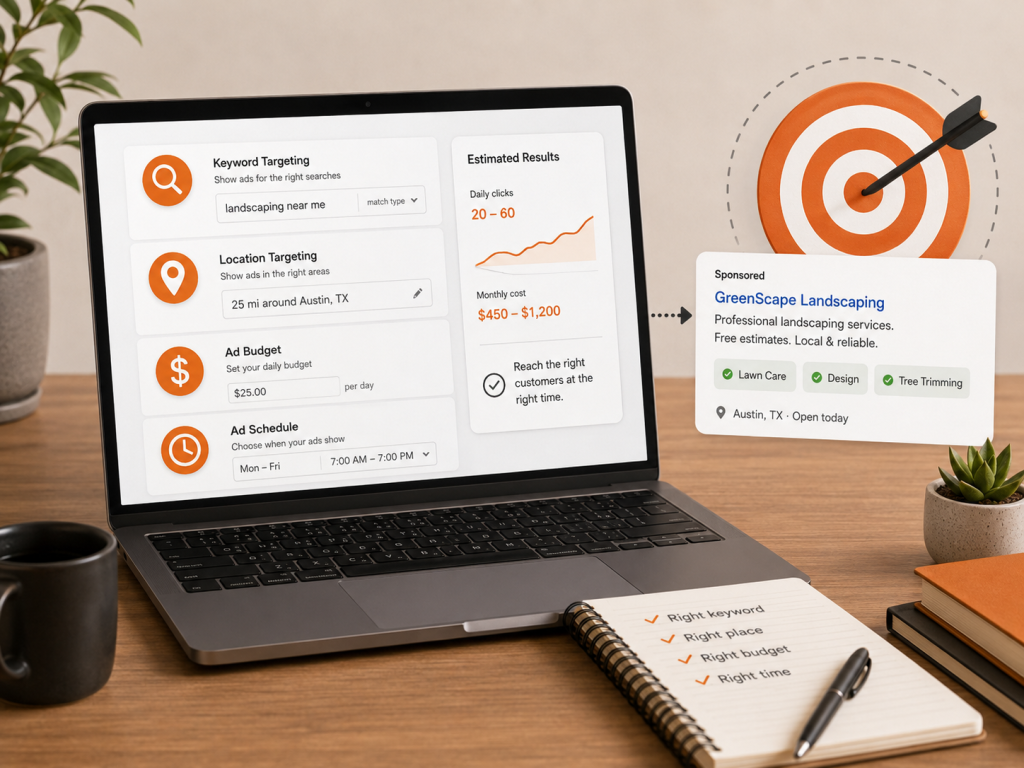
It’s precise. You can target by location, time of day, device, keywords people search, and even their interests, so you’re not wasting money on people who’ll never buy.
The honest downsides
PPC isn’t magic, and it’s only fair to mention the trade-offs.
The most important one: it stops the moment you stop paying. PPC is like renting visibility. The day your budget runs out, your ads disappear. That’s the opposite of SEO and content, which keep working after you’ve invested in them.
It also costs add up quickly if it’s not managed well. Bidding on the wrong keywords, sending clicks to a weak landing page, or failing to track conversions can quietly burn through a budget with little to show for it. PPC rewards attention and expertise — it’s easy to start, but easy to waste money on too.
PPC vs. SEO: a quick word
People often ask whether they should do PPC or SEO. They’re not rivals so much as different tools. PPC buys you speed and immediate visibility; SEO builds long-term, lower-cost traffic over time. Many successful businesses use both — PPC to capture demand now, SEO to build a foundation that lowers their reliance on ads later.
Is PPC right for your business?
It tends to be a strong fit if:
- People actively search for what you offer (services, products, solutions to a problem).
- You can afford to pay for customers and still profit — in other words, your margins support it.
- You want results sooner rather than later, or you’re testing a new offer.
- You have a clear next step on your website for visitors to take.
It may be less urgent if your margins are very thin, if almost nobody searches for what you do, or if your website isn’t yet set up to convert the traffic you’d be paying for.
The bottom line
PPC is, at its core, a simple deal: you pay only when someone clicks your ad, and in return you get fast, measurable, highly targeted visibility in front of people who are often already looking for you. It’s one of the quickest ways to turn a marketing budget into real leads — when it’s set up and managed well.
That last part is the catch. The mechanics are simple, but the difference between a campaign that profits and one that quietly drains your budget usually comes down to the details: the right keywords, sharp ad copy, a landing page that converts, and proper tracking.
If you’d like to know whether PPC makes sense for your business — and roughly what it might cost and return — that’s exactly the kind of thing we can help you map out before you spend a dollar.