

For the better part of two decades, “getting found online” meant one of two things: ranking on Google or buying Google Ads. That playbook is starting to change. In early 2026, OpenAI began placing ads directly inside ChatGPT, the AI assistant that now handles billions of prompts a day. For small and mid-sized businesses, that opens up an entirely new place to reach customers at the exact moment they’re asking for help.
So what are ChatGPT ads, how do they actually work, and should your business pay attention? Here’s the plain-English breakdown.
What are ChatGPT ads?
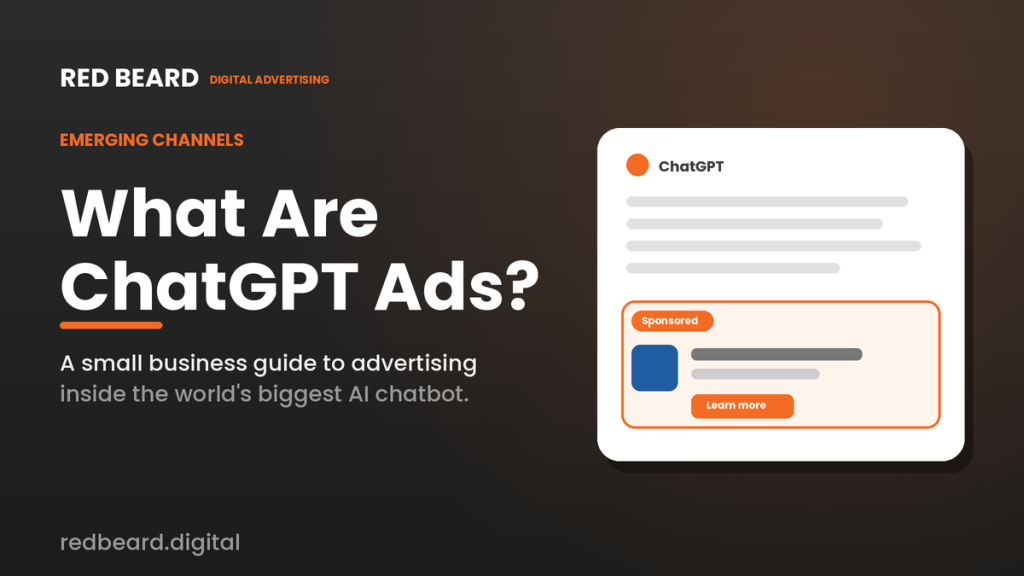
ChatGPT ads are sponsored placements that appear inside ChatGPT conversations. Instead of interrupting an answer, they appear as clearly labeled, lightly shaded cards, usually at the bottom of a response, so users can distinguish ChatGPT’s actual answer from a paid message from a business.
The key idea is relevance. If someone is chatting with ChatGPT about fixing a leaky water heater, an ad for a local plumbing or water-treatment company is far more useful (and far more likely to convert) than a random banner. ChatGPT ads are built to slot into that moment of high intent.
How do ChatGPT ads work?
ChatGPT ads work differently from the search and social ads most business owners are used to. Three things stand out:
1. Contextual targeting instead of keyword bidding. Rather than bidding on a list of keywords, ChatGPT matches ads to the topic of the conversation, the user’s general location, and language. The targeting is based on what the person is actually trying to accomplish in that chat, which is a deeper signal than a single typed search term.
2. Ads stay separate from answers. OpenAI has been clear that ads don’t change or influence ChatGPT’s responses — the AI’s answer is generated independently, and sponsored content sits alongside it in a labeled box. That separation is central to keeping user trust, and it matters for advertisers too: your ad appears next to a genuinely helpful answer rather than hijacking it.
3. Privacy is built into the model. Advertisers don’t get access to people’s individual conversations or personal details. You’re reaching an audience based on context and intent, not by reading private chats.
Who actually sees ChatGPT ads?
Not everyone. Ads currently appear for people on ChatGPT’s free and lower-cost tiers — the casual, everyday users — while subscribers on the premium Plus, Pro, Team, and Enterprise plans remain ad-free for now. The rollout started in the United States and has been expanding into additional markets, including Canada, Australia, and New Zealand.
For a local home-services business, that free-tier audience is exactly the broad, general-public pool you want: homeowners, renters, and small-business owners casually asking ChatGPT for recommendations and how-to help.
How much do ChatGPT ads cost?
This is the part still settling into place. When the ad program first opened, it was limited to large advertisers with big minimum commitments. Over 2026, OpenAI rolled out a self-serve Ads Manager — similar in spirit to Google Ads or Meta Ads Manager — that lets businesses of nearly any size build and manage campaigns themselves.
That platform supports both cost-per-click (CPC) bidding, where you pay when someone clicks, and cost-per-impression (CPM) bidding, where you pay for visibility. Pricing is still evolving and tends to run higher than traditional display advertising, which reflects how valuable that high-intent, in-conversation audience is. The practical takeaway: it’s no longer a channel reserved for national brands, but you’ll still want a clear budget and conversion-tracking setup before you jump in.
ChatGPT ads vs. Google Ads: what’s the difference?
If Google Ads catches people searching for a solution, ChatGPT ads catch them thinking out loud about a problem. A Google search is often a short phrase typed in a hurry. A ChatGPT conversation is usually longer, more detailed, and more revealing about what the person actually needs.
That makes ChatGPT a fundamentally different kind of advertising surface. It’s less about matching an exact keyword and more about showing up in the middle of a real decision-making conversation. For many local businesses, the two channels will complement each other rather than compete — Google for direct-intent searches, ChatGPT for the research-and-recommendation moments that happen earlier in the buying journey.
Should your small business care about ChatGPT ads?
Maybe — and the smartest move right now is to prepare rather than rush. A few things to keep in mind:
- It’s early, which is an advantage. Ad inventory is new and competition is thinner than on Google or Meta. Businesses that learn the platform early tend to capture lower costs and better placements before everyone else piles in.
- Conversational copy wins. Banner-ad language and keyword-stuffed headlines don’t fit a chat experience. Ads that read like a genuinely helpful recommendation perform best.
- Tracking is non-negotiable. As with any paid channel, you need call tracking and conversion data to know whether ChatGPT ads are producing real leads — not just clicks.
- It’s part of a bigger AI shift. ChatGPT ads are one piece of a broader move toward AI-driven discovery. The same trend is reshaping organic visibility, too, which is why getting your business optimized for AI search now pays off across the board.
The bottom line
ChatGPT ads represent the first real advertising channel built inside a mainstream AI assistant — and they reach people at a uniquely high-intent moment. For small and mid-sized businesses, especially in competitive local and home-services markets, it’s a channel worth understanding before your competitors do.
At Red Beard Digital, we help local businesses stay ahead of exactly these shifts — from Google and Meta ads to emerging AI platforms — with strategies built around real, trackable leads instead of vanity metrics. Want to know whether ChatGPT ads fit your marketing mix? Book a free strategy call and let’s map it out.