

The way people find businesses online is changing fast. A few years ago, someone with a broken air conditioner typed “AC repair near me” into Google and clicked a link. Today, that same person might ask Google, ask a voice assistant, or ask ChatGPT to recommend a company.
That shift has created three buzzwords: SEO, AEO, and GEO. They can sound confusing, but the ideas behind them are simple. Knowing the difference can help you decide where to spend your time and money.
As a digital marketing agency that helps local businesses get found online, we hear questions about this every week. Here is a plain-English guide to what each term means, how they differ, and what actually matters for your business.
The Short Answer
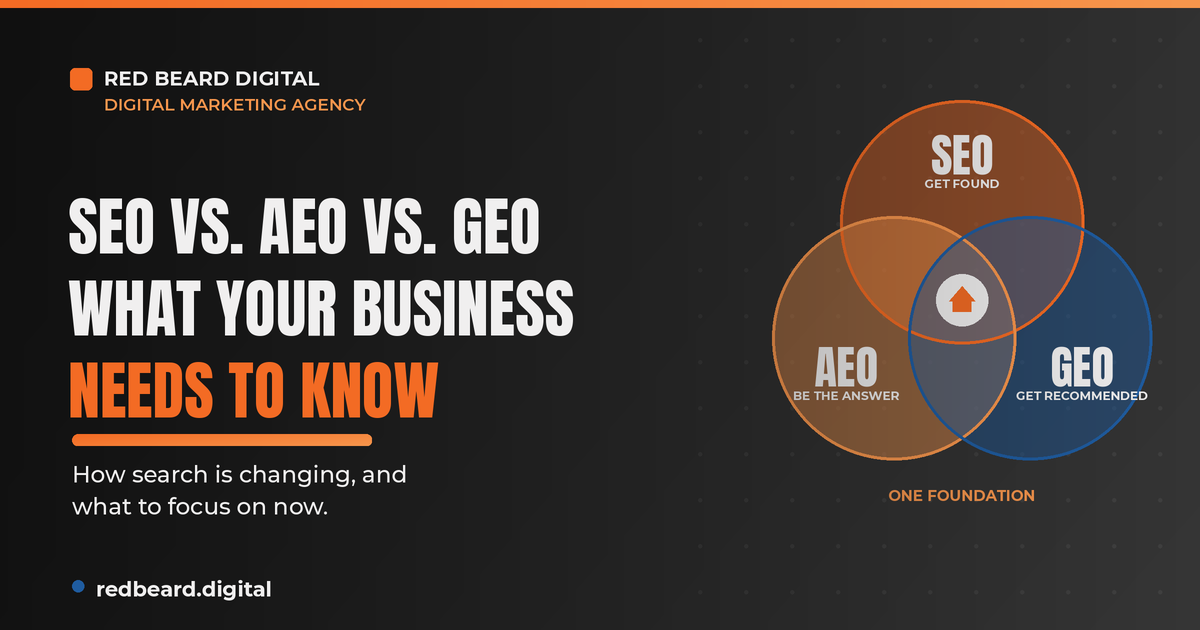
SEO helps your website rank in search results. AEO helps your content become the answer. GEO helps AI tools mention and recommend your business.
All three share the same goal: making sure customers find you when they need what you sell.
What Is SEO (Search Engine Optimization)?
SEO is the work of improving your website so it shows up higher in search engines like Google and Bing. It has been around for more than 20 years, and it is still the base of being found online.
Good SEO includes:
- Technical health: Your site loads fast, works well on phones, and is easy for Google to read.
- Helpful content: Your pages clearly explain your services and answer customer questions.
- Keywords: You use the words your customers actually type, like “water heater repair in Fort Myers.”
- Authority: Other trusted websites link to yours, and your business has strong reviews.
The goal: Rank high and earn the click.
How you measure it: Rankings, website visits, and leads from search.
What Is AEO (Answer Engine Optimization)?
AEO is about becoming the answer instead of just one link on a list. When you search a question on Google, you often see a direct answer at the top of the page. That might be a featured snippet, a “People Also Ask” box, or an AI Overview. Voice assistants like Siri and Alexa also read short answers out loud.
AEO means writing content that these tools can easily pull out and share. That includes:
- Answering common questions clearly, often in the first sentence or two.
- Using question-style headings, like “How often should I service my AC?”
- Organizing content with short paragraphs, lists, and FAQ sections.
- Adding schema markup. This is behind-the-scenes code that helps search engines understand your page.
The goal: Be the answer people see or hear first.
How you measure it: Featured snippets, “People Also Ask” spots, and AI Overview appearances.
What Is GEO (Generative Engine Optimization)?
GEO is the newest of the three. It is about getting your business mentioned by AI tools that write full answers, such as ChatGPT, Google Gemini, Perplexity, and Claude.
These tools don’t just show a list of links. They read information from many sources and write a summary. If someone asks, “Who are the best HVAC companies in Cape Coral?” the AI decides which businesses to name. GEO is about earning a spot in that answer.
AI tools tend to favor businesses that:
- Show up the same way across the web, with the same name, address, and phone number.
- Are mentioned on other trusted websites, like local news, industry groups, and review sites.
- Publish clear, accurate, expert content that is easy to quote.
- Have plenty of real customer reviews.
The goal: Get your brand named and cited in AI answers.
How you measure it: How often AI tools mention your business, and visits that come from AI platforms.
SEO vs. AEO vs. GEO at a Glance
| SEO | AEO | GEO | |
|---|---|---|---|
| Full name | Search Engine Optimization | Answer Engine Optimization | Generative Engine Optimization |
| Main goal | Rank in search results | Be the direct answer | Be named by AI tools |
| Where you show up | Google and Bing results | Featured snippets, AI Overviews, voice assistants | ChatGPT, Gemini, Perplexity, Claude |
| What success looks like | Clicks to your website | Your answer shown at the top | Your brand named in AI replies |
| Key ingredients | Technical health, keywords, links | Clear answers, FAQs, schema | Trust, reviews, mentions across the web |
Why This Matters Right Now
The biggest reason to pay attention is simple: AI answers are changing how often people click.
When Google shows an AI Overview, many people get what they need without visiting any website. The research backs this up:
- An Ahrefs study found that when an AI Overview appears, the top-ranking page gets about 58% fewer clicks on average.
- A randomized study from early 2026 found that AI Overviews cut clicks to regular results by 38% on searches where they showed up.
But there is a bright side. Data from Seer Interactive shows that pages cited inside an AI Overview get more than twice the click rate of pages that are left out. Being part of the AI answer is far better than being skipped.
So the question is no longer just “Do we rank?” It is also “Are we the answer?” and “Does AI recommend us?”
The Good News: They All Share the Same Foundation
Here is something many agencies won’t tell you: you don’t need three separate strategies.
In May 2026, Google published official guidance on how to appear in its AI features, like AI Overviews and AI Mode. The message was clear. These features run on the same core systems as regular Google search. Good SEO is still how you show up there, and no special tricks are needed.
That is why we treat SEO as the foundation, with AEO and GEO built on top of it. If Google can’t find, read, and trust your website, AI tools probably won’t either.
One note: Google’s guidance only covers Google’s own search features. Tools like ChatGPT and Perplexity run on their own systems. They still reward the same basics, like clear content, a strong reputation, and trusted mentions. But it’s smart to track them on their own.
What This Means for Local and Home Service Businesses
If you run a local business, like an HVAC, plumbing, or roofing company, this part matters most.
AI Overviews show up far more often on research questions than on buying searches. Seer Interactive found AI Overviews appear on about 36% of research-style searches, but only about 5% of buying searches.
Here is what that looks like in real life:
- “Why is my AC blowing warm air?” This is a research question. An AI answer will likely appear, so AEO and GEO matter here.
- “AC repair near me.” This is a buying search. The map pack, local ads, and regular results still lead the way, so SEO and your Google Business Profile matter most.
The smart move is to cover both. Strong local SEO catches people who are ready to hire today. Helpful, answer-focused content builds trust earlier, so your name is already familiar when they’re ready to call.
7 Key Factors Every Business Needs to Get Right
- Nail the technical basics. Make sure your site is fast, works on phones, is secure, and is easy for search engines to read. Everything else depends on this.
- Answer real customer questions. Write down the questions your team hears every week. Turn each one into a clear answer on your website.
- Lead with the answer. Put the short answer first, then explain. This helps readers, search engines, and AI tools all at once.
- Use clear structure. Use headings, short paragraphs, lists, and FAQ sections so your content is easy to scan and quote.
- Add schema markup. Code like LocalBusiness and FAQ schema helps search engines understand who you are and what you offer.
- Keep your business info the same everywhere. Your name, address, phone number, and hours should match on your website, your Google Business Profile, and every directory. AI tools compare these sources.
- Build real trust. Earn reviews, show your licenses and experience, and get mentioned on trusted local sites. Skip shortcuts like paying for fake mentions. Google has said these are not likely to help.
Common Myths About AI Search
Myth: “SEO is dead.” Not even close. Google’s own guidance says SEO is still how you show up in its AI features. SEO is the base that everything else stands on.
Myth: “You need a secret trick to show up in AI answers.” For Google’s AI features, Google says there are no extra requirements beyond good SEO. Be wary of anyone selling a shortcut.
Myth: “You need separate content written just for AI.” The same helpful, well-organized content works for people, search engines, and AI tools. Write for your customers first.
How to Tell If It’s Working
Track a mix of signals:
- Google Search Console: Watch clicks, impressions, and rankings. Google counts AI Overview and AI Mode appearances in your overall Search Console data.
- AI visits: In Google Analytics, look for visits coming from sites like chatgpt.com and perplexity.ai.
- AI spot checks: Ask ChatGPT, Gemini, and Perplexity about your services in your area. See if your business gets named.
- Leads: Track calls, form fills, and booked jobs. This is the number that matters most, and call tracking shows which channels bring in real customers.
Frequently Asked Questions
Is AEO different from SEO? AEO is a part of SEO that focuses on giving direct answers. It uses the same foundation but puts extra focus on clear answers, question-style headings, and well-organized content.
Is GEO replacing SEO? No. GEO builds on SEO. AI tools still rely on websites that are easy to find, read, and trust. Without strong SEO, GEO is much harder.
How long does it take to see results? SEO usually takes several months to build momentum. AEO and GEO updates can show up once search engines and AI tools re-read your pages. Lasting results come from steady work over time.
Should a small business worry about AI search yet? Yes, but there’s no need to panic. Start by making your SEO strong and your content helpful. Those same steps improve your chances in AI answers.
The Bottom Line
SEO, AEO, and GEO are not three separate races. They are three ways of chasing one goal: being the business customers find, trust, and choose. SEO gets you found. AEO makes you the answer. GEO gets you recommended.
The businesses that win won’t chase every new buzzword. They’ll build a strong foundation and keep it up to date as search changes.
At Red Beard Digital, we help local businesses build search strategies that work across Google results, AI Overviews, and AI tools like ChatGPT. We back every plan with clear tracking, so you can see what’s bringing in real leads. Schedule a free consultation and let’s make sure your business shows up wherever your customers are searching.