

More and more people are skipping the list of links. Instead, they ask ChatGPT a question, read the AI Overview at the top of Google, or ask Siri or Gemini out loud. Then they make a choice, often without visiting a single website.
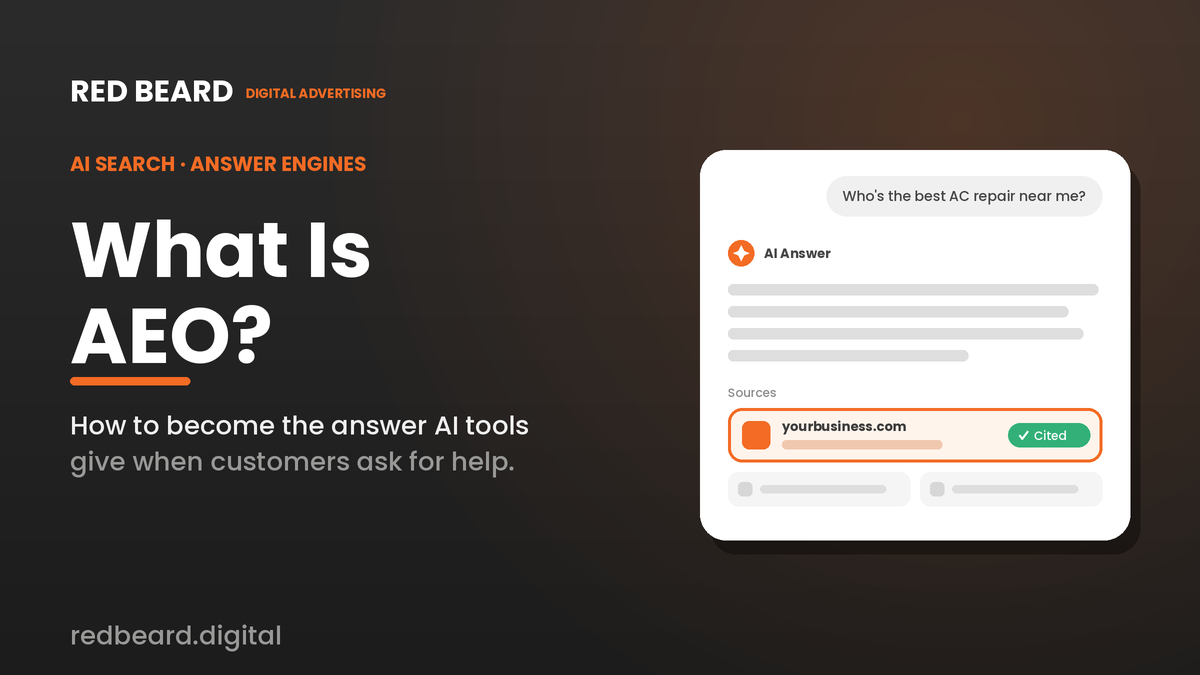
That shift changes how customers find businesses. When someone asks an AI tool, “Who is the best AC repair company near me?” you want your business to be part of the answer. That is what AEO is all about.
In this guide, we explain what AEO is, how it connects to SEO, and the key factors that decide whether AI tools mention your business.
What is AEO?
AEO stands for answer engine optimization. It is the work of helping your business show up inside the answers that AI tools give people.
An answer engine is any tool that gives a direct answer instead of just a list of links. The most common ones include:
- ChatGPT
- Google AI Overviews and AI Mode
- Google Gemini
- Perplexity
- Microsoft Copilot
- Claude
- Voice assistants like Siri and Alexa
These tools gather information from across the web and turn it into a short, written answer. Many of them also list the websites they used. When an AI tool lists your website as a source, that is called a citation. When it names your business in the answer, that is a mention. Good AEO aims to earn both.
Here is the simplest way to think about it: SEO helps you rank. AEO helps you get quoted.
AEO vs. SEO: What’s the difference?
SEO stands for search engine optimization. It helps your pages rank in regular Google results so people click through to your site.
AEO has a slightly different goal. It helps your business become the trusted source an AI tool picks when it builds an answer.
The two are not rivals, though, because AEO is built on top of SEO. In May 2026, Google published official guidance for its AI features. It said that optimizing for AI search on Google “is still SEO.” Google’s AI Overviews and AI Mode use the same search index and ranking systems as its regular results. So strong SEO is always step one.
But Google is only one answer engine, and other AI tools choose their sources in their own way. One study found that only about 20% of the pages cited by ChatGPT and Perplexity also ranked in Google’s top 10 for the same search. Ranking well on Google helps a lot, but it does not guarantee you will show up everywhere.
Why AEO matters for your business right now
The way people search is changing fast. Here is what the numbers show:
- Fewer clicks. Nearly 60% of Google searches now end without a click to any website.
- More AI shopping. 72% of consumers say they plan to use AI more often when they shop.
- AI answers shape buying. In a 2026 HubSpot survey, nearly half of marketers said they made a business purchase based mainly on a brand they first found in an AI answer.
- Few businesses are watching. Only about 11% of brands track how visible they are in AI answers.
For a local service business, the stakes are simple. When a homeowner asks an AI tool who to call, it may name just two or three companies. If you are not one of them, you may never get a shot at that job. The good news is that most of your competitors are not working on this yet.
The key AEO factors every business needs to understand
AEO is not one trick. It is a group of factors that work together, and these are the ones that matter most.
1. A strong SEO foundation comes first
AI tools can only use pages they can find and read. Your website needs to be fast, secure, mobile-friendly, and easy for search engines to crawl. Google says a page must be indexed and able to show in regular search before it can appear as a link in AI Overviews or AI Mode.
If your site has technical problems, fix those before anything else, because every other factor on this list depends on them.
2. Put the answer first
AI tools look for clear, direct answers they can pull from a page. One study found that about 44% of AI citations come from the first 30% of a page’s text. In other words, the top of your page matters most.
Start each page and each section with a short, plain answer, and then add the details. Use headings that match real questions, like “How much does a new AC unit cost?” This makes your content easy for both people and AI tools to use.
3. Answer the questions your customers really ask
People talk to AI tools in full sentences. They ask things like, “How long does it take to replace a roof in Fort Myers?” Your best content ideas come from the questions you already hear on the phone, in emails, and in reviews.
Google’s AI features also run many related searches behind the scenes to build one answer. Google calls this “query fan-out.” Pages that cover a topic fully, including the follow-up questions, give AI tools more reasons to use your content.
4. Be useful and original
Google’s guidance says to focus on valuable, unique content, not the same generic advice found everywhere else. Share what only you know. That might be real price ranges, lessons from local jobs, photos of your work, or tips from your team’s years of experience.
If your page says the same thing as a hundred other pages, an AI tool has no good reason to choose yours over theirs.
5. Keep your business information the same everywhere
AI tools piece together facts about your business from many places. They look at your website, your Google Business Profile, review sites, social media, and online directories. If your name, address, phone number, hours, or services don’t match across those places, AI tools can get confused. A confused AI tool may simply leave you out.
Clear local service pages also help. They tell answer engines exactly what you do and which areas you serve.
6. Earn mentions and reviews on other websites
This is the factor most businesses miss: AI tools trust what other people say about you more than what you say about yourself. A May 2026 study of more than 25 million AI citations found that about 84% came from earned media, not from a company’s own website. Another 2026 study found Reddit was the most-cited website across the major AI platforms.
For your business, that means:
- Steady, real reviews on Google and other trusted review sites
- Mentions in local news, community groups, and industry associations
- Helpful answers in online forums where your customers ask questions
- Links and mentions from partners, suppliers, and local organizations
One warning: never fake it. In May 2026, Google updated its spam rules to cover AI answers. Fake mentions made to trick AI tools now count as spam.
7. Structured data helps, but it is not a magic trick
Structured data, also called schema markup, is code that labels information for machines so search engines can read details like your business type, hours, and services. It is still a smart part of good SEO.
But be careful with anyone selling AEO “hacks.” Google says you do not need special schema, an llms.txt file, or pages rewritten just for AI to show up in its AI features. The basics still win.
8. Track your AI visibility
You can’t improve what you don’t measure. Luckily, the tools are catching up:
- Google Search Console began rolling out reports in June 2026 that show how often your pages appear in AI Overviews and AI Mode.
- Google Analytics 4 now has an “AI Assistant” channel. It shows visitors who came from tools like ChatGPT, Gemini, and Claude.
- Manual checks still matter. Ask AI tools the same questions your customers ask, and write down who gets named.
Keep in mind that AI answers change often, and the same question can bring up different sources from one day to the next. That is why tracking over time beats checking once.
How to get started with AEO
Ready to take the first steps? Here is a simple starting plan:
- Search for yourself. Ask ChatGPT, Gemini, and Google AI Mode the questions your customers ask. Note who shows up and who doesn’t.
- Fix the technical basics. Make sure your site is fast, secure, and fully indexed.
- Rewrite your top service pages. Put a clear, direct answer in the first paragraph of each one.
- Add real FAQs. Use the exact questions customers ask you, with short, honest answers.
- Clean up your listings. Make your business details match everywhere they appear.
- Build a review and mention plan. Make asking for reviews and earning local mentions a steady habit.
- Set up tracking. Turn on the AI reports in Search Console and watch the AI Assistant channel in GA4.
Frequently asked questions about AEO
Is AEO replacing SEO? No. AEO builds on SEO. Google has said that optimizing for its AI features is still SEO. A business with weak SEO will almost always struggle with AEO too.
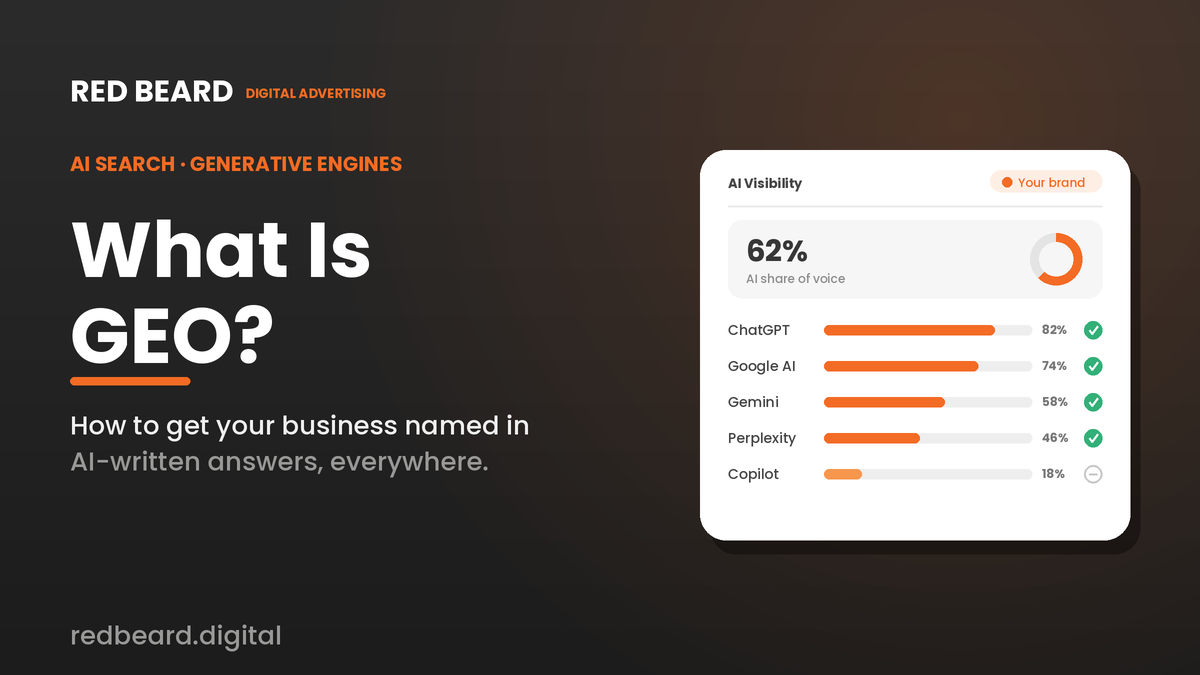
What is the difference between AEO and GEO? GEO stands for generative engine optimization. The two terms are mostly used for the same goal: showing up in AI-generated answers. Google treats both as part of SEO.
How long does AEO take to work? Like SEO, AEO is a long-term effort. Some fixes, like cleaning up listings or rewriting key answers, can help fairly quickly. Building trust and earning outside mentions usually takes several months.
Can I just pay to show up in AI answers? Some AI tools now sell ads, such as ChatGPT ads. Those ads appear in a labeled box, separate from the answer itself. AEO is about earning a place inside the answer, which ads cannot buy.
Do small local businesses really need AEO? Yes. Local questions like “best plumber near me” are exactly the kind people now ask AI tools. Local businesses that start early have a real chance to become the go-to name in their area.
Why work with a specialist AEO agency?
AEO touches almost every part of your online presence, including technical SEO, content, local listings, reviews, digital PR, and analytics. Each piece affects the others, and the rules keep changing, sometimes from month to month.
A specialist agency ties all of those pieces together and cuts through the hype. Many AEO “tricks” being sold today do nothing, and some can even hurt you. The right partner focuses on what actually moves the needle: a strong foundation, genuinely helpful content, and real trust signals across the web.
The bottom line
AEO is how your business shows up when customers ask AI tools for help. It is not a replacement for SEO but the next layer on top of it. The businesses that win will be the ones with strong websites, clear answers, consistent information, and a good reputation across the web.
At Red Beard Digital, we build AEO into our SEO work for local and home service businesses. That means technical fixes, answer-first content, local listing cleanup, review and mention strategies, and clear tracking through Google Search Console and Google Analytics. Everything is measured by calls and booked jobs, not vanity metrics. Want to know if AI tools are recommending you or your competitors? Book a free strategy call and we’ll show you where you stand.