

Ask ChatGPT for the best roofer in your town, and it won’t hand you a page of ten blue links. It writes an answer. It may name two or three companies, explain why it picked them, and stop there. If your business isn’t in that answer, the customer may never know you exist.
That is the problem GEO solves. In this guide, we explain what GEO is, where it came from, how it compares to SEO and AEO, and the factors that decide whether AI tools name your business.
What is GEO?
GEO stands for generative engine optimization. It is the practice of helping your business get mentioned, cited, and recommended in answers written by AI tools.
A generative engine is an AI tool that writes, or “generates,” a brand-new answer instead of just showing a list of websites. The big ones today include:
- ChatGPT
- Google AI Overviews and AI Mode
- Google Gemini
- Perplexity
- Microsoft Copilot
- Claude
These tools are now part of everyday life. ChatGPT alone receives about 2.5 billion prompts every day. Google’s AI Overviews also show up on far more searches than before, with coverage growing 58% in a single year.
One quick note: in marketing, “geo” can also mean geographic, as in geo-targeting ads to a certain area. In this article, GEO means optimizing for AI.
Where did GEO come from?
The term comes from a 2023 research paper written by a team from Princeton University, Georgia Tech, the Allen Institute for AI, and IIT Delhi. The researchers tested how different changes to web content affected whether AI tools used that content in their answers. They ran their tests across about 10,000 search questions.
Their best methods raised a page’s visibility in AI answers by up to 40%. Three changes stood out:
- Adding real statistics instead of vague claims
- Citing trustworthy sources for the facts on the page
- Including quotes from credible experts
Just as important, the study found that stuffing in extra keywords did not help much. And pages that ranked lower in regular search saw some of the biggest gains. That is good news for small businesses, because you don’t have to be the biggest brand in your market to get named.
GEO vs. SEO vs. AEO: What’s the difference?
These three terms overlap a lot, so here is a simple way to keep them straight:
- SEO (search engine optimization) helps your pages rank in search results so people click to your site.
- AEO (answer engine optimization) helps your content become the direct answer to a specific question.
- GEO (generative engine optimization) helps your brand get mentioned and recommended inside AI-written answers across many platforms.
Many marketers use AEO and GEO to mean almost the same thing. Google treats both as part of good SEO. In its 2026 guidance, Google said optimizing for its AI features “is still SEO,” because those features use the same index and ranking systems as regular search.
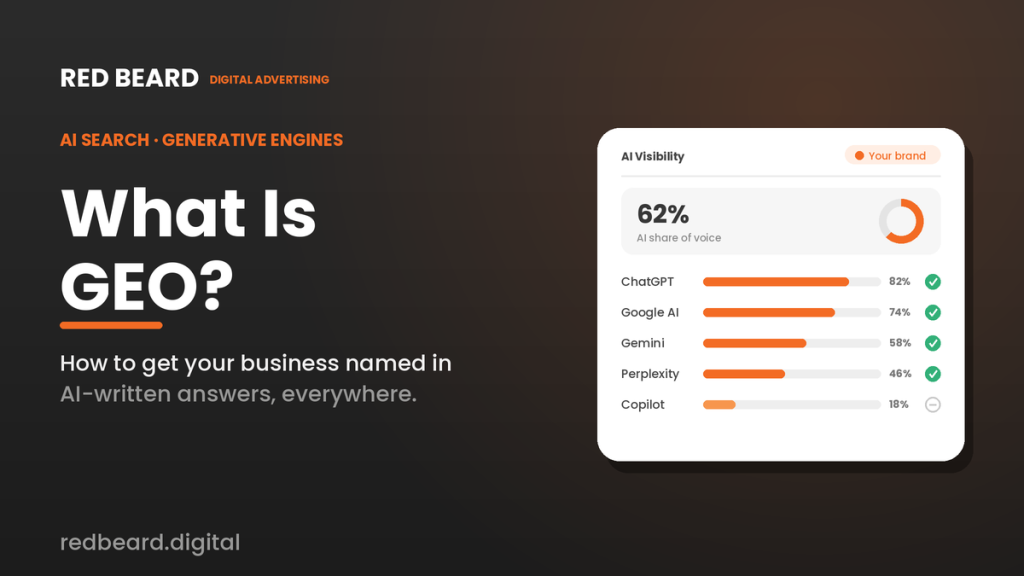
The biggest difference is how you measure success. SEO looks at rankings, clicks, and traffic. GEO looks at mentions, citations, and share of voice. Share of voice means how often AI tools name your business compared with your competitors.
There is also a mindset shift. On a regular results page, being in spot number seven still gets you seen. In an AI answer, there may be room for only three names. You are either in the answer or you are not.
Why GEO matters for local and service businesses
The way AI tools build answers creates real risks, and real openings, for local businesses:
- Fewer names make the cut. AI tools often recommend only a small handful of companies, so every spot matters.
- Answers come from the whole web. AI tools don’t just read your website. They read reviews, forums, videos, news stories, and directories, then combine what they find.
- Answers change often. When Semrush tracked 2,500 prompts in Google AI Mode and ChatGPT, it found that 40% to 60% of the cited sources changed from month to month. A competitor who is named today can lose that spot tomorrow, and so can you.
- Answers can be personal. Google’s AI Mode can tailor results to each user, so two customers asking the same question may see different businesses.
The key GEO factors every business needs to understand
GEO is not a single trick. It is a set of factors that work together. Here are the ones that matter most.
1. Strong SEO is still the foundation
AI tools need good sources, and they often find them through search. Google’s AI Overviews and AI Mode pull from the same index as its regular results. If your website is slow, hard to crawl, or thin on helpful content, GEO will be an uphill climb. Fix the basics first.
2. Make sure AI tools can read your website
AI tools use automated programs called crawlers to read web pages. Some websites block these crawlers by accident through their robots.txt file or security settings. Make sure your site allows search crawlers like Googlebot, Bingbot, OpenAI’s OAI-SearchBot, and PerplexityBot.
It also helps to keep important information in plain text on the page. Facts that only appear inside images, PDFs, or pop-ups are harder for AI tools to read and quote.
One helpful detail: some AI companies use separate crawlers for training their models. Blocking a training crawler, like OpenAI’s GPTBot, is a different choice from blocking search, and it won’t keep you out of ChatGPT’s search answers.
3. Make your content easy to quote
AI tools love clear, specific facts they can repeat with confidence. The original GEO research found that statistics, sources, and expert quotes made the biggest difference.
For a home service company, that might look like:
- “Most tank water heaters last about 8 to 12 years,” with a link to a trusted source
- Real numbers from your own work, such as how many systems your team installed last year
- A short quote from your lead technician about a common repair mistake
Write key facts in short sentences that make sense on their own. Use clear headings, and put the main answer near the top of each section. That makes it easier for AI tools to pull the right piece of your page.
4. Be crystal clear about who you are
AI tools think in terms of entities: businesses, people, places, and how they connect. Your goal is to make sure AI tools clearly connect your business name with your services and the area you serve.
That means using the same business name, address, phone number, and hours everywhere. It also means having a strong About page, service pages that name the cities you serve, and a complete Google Business Profile. Structured data can help label these facts for machines, but it works best as support for clear content, not a replacement for it.
5. Show up where AI tools look
This is where GEO differs most from traditional SEO. AI tools lean heavily on what other websites say about you. A May 2026 study of more than 25 million AI citations found that about 84% came from earned media, not from a company’s own website.
Some platforms carry extra weight. YouTube accounts for roughly 23% of the sources cited in Google’s AI Overviews. Reddit was the most-cited website across the major AI platforms in a 2026 study. LinkedIn also climbed quickly, moving from 11th to 5th among ChatGPT’s most-cited sources in just a few months.
For a local business, building this kind of presence can include:
- Steady, real reviews on Google and trusted sites like Yelp, Angi, or the BBB
- Short YouTube videos that answer common customer questions
- Mentions in local news, community groups, and trade associations
- Honest, helpful answers in online forums where homeowners ask for advice
6. Build real trust, and never fake it
AI tools look for signs that a business is real and reliable. Reviews, real job photos, licenses, named experts, and years in business all help.
Shortcuts can backfire. In May 2026, Google updated its spam rules to cover AI answers. Fake mentions, made-up reviews, and content created only to game AI tools now count as spam.
7. Measure your share of voice over time
You can’t improve what you don’t measure. Start by listing 20 to 50 real questions your customers ask. Then ask those questions in several AI tools each month. Write down whether your business is named, which competitors appear, and which websites the AI cites.
Newer tools can help too. Google Search Console began rolling out reports in June 2026 that show how often your pages appear in AI Overviews and AI Mode. Google Analytics 4 now has an “AI Assistant” channel that shows visits from tools like ChatGPT, Gemini, and Claude. Bing Webmaster Tools also offers an AI performance report.
Because AI answers change so often, look for trends over several months instead of judging by a single check.
Common GEO myths
As with any new topic, GEO comes with a lot of bad advice. Here are a few myths to avoid:
- “GEO replaces SEO.” It doesn’t. GEO builds on SEO, and weak SEO makes GEO much harder.
- “More keywords will get AI to notice you.” The original GEO research found keyword stuffing did not help much.
- “You need an llms.txt file.” Google says you don’t need one for its AI features.
- “You can buy your way into the answer.” Some AI tools now sell ads, like ChatGPT ads, but those appear in labeled boxes separate from the answer itself.
- “Only big brands get mentioned.” The research showed that lower-ranked pages can gain the most from better content.
How to get started with GEO
Here is a simple plan to begin:
- Run an AI visibility check. Ask ChatGPT, Gemini, Perplexity, and Google AI Mode the questions your customers ask. Note who gets named.
- Open the door to AI crawlers. Check your robots.txt file and security settings.
- Add facts, numbers, and sources to your most important service pages.
- Tighten your business details so they match everywhere online.
- Grow your presence beyond your website through reviews, video, local press, and community involvement.
- Track your share of voice monthly and adjust based on what you see.
Frequently asked questions about GEO
What does GEO stand for in marketing? GEO stands for generative engine optimization. It is the practice of helping a business get mentioned, cited, and recommended in answers written by AI tools like ChatGPT, Gemini, Perplexity, and Google AI Overviews.
Is GEO the same as AEO? They are very close. AEO focuses on becoming the direct answer to a question. GEO focuses on getting your brand mentioned and recommended across AI tools. Many marketers use the terms interchangeably, and both build on SEO.
Can a small business compete in GEO? Yes. In the original GEO research, pages that ranked lower in regular search saw some of the biggest gains from better content. Clear facts, strong reviews, and consistent local information help small businesses get named.
Should I block AI crawlers from my website? Usually not, if you want customers to find you. Blocking AI search crawlers can keep your business out of AI answers. Crawlers that collect data to train AI models are a separate choice, and you can block those without blocking search.
How long does GEO take to work? Some fixes, like opening your site to AI crawlers or cleaning up business listings, can help fairly quickly. Building reviews, mentions, and trust across the web usually takes several months. Because AI answers change often, GEO works best as an ongoing effort.
Why work with a specialist GEO agency?
GEO touches nearly every part of your online presence, from technical SEO and content to reviews, video, local PR, and analytics. Each piece affects the others, and AI tools change how they choose sources all the time.
A specialist agency connects those pieces and keeps up with the changes, so you don’t have to. Just as important, a good partner will steer you away from shortcuts that waste money or put your reputation at risk.
The bottom line
GEO is how your business gets named when customers ask AI tools for help. It builds on strong SEO, then adds quotable content, clear business details, a strong reputation across the web, and steady tracking. The businesses that start now will be the names AI tools learn to trust first.
At Red Beard Digital, we help local and home service businesses get found in both traditional search and AI answers. That includes technical fixes, fact-rich content, listing cleanup, review and mention strategies, and tracking that ties AI visibility back to calls and booked jobs. Want to know if ChatGPT and Google’s AI are recommending you or your competitors? Book a free strategy call and we’ll run an AI visibility check on your business.