

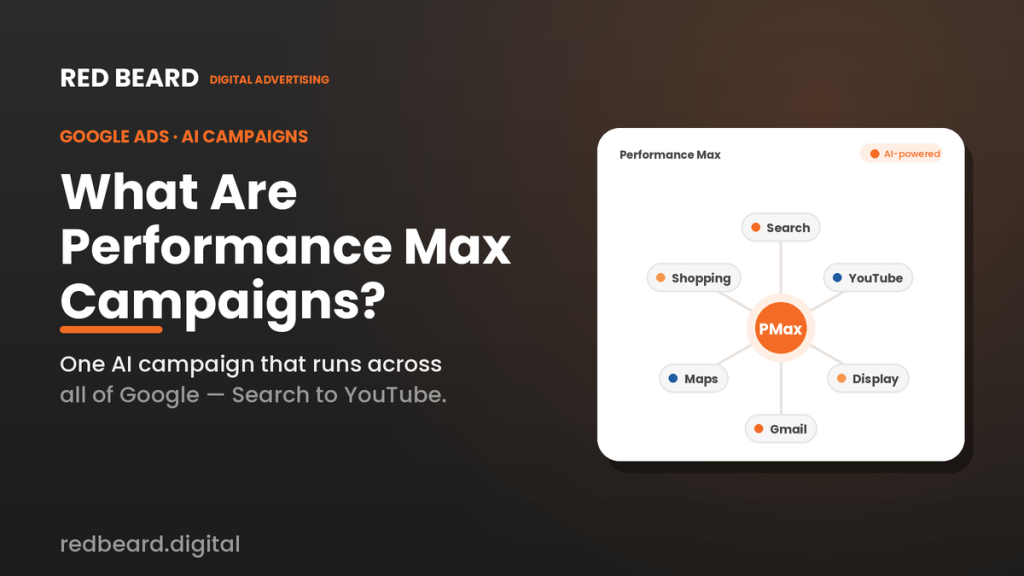
Imagine running one Google Ads campaign that automatically shows your ads on Google Search, YouTube, Gmail, Maps, and across the web with Google’s AI deciding where, when, and to whom to show them for the best results. That’s Performance Max. It’s become one of the most important campaign types in all of Google Ads, but it’s also one of the most misunderstood. Here’s a plain-English guide to what Performance Max campaigns are, how they work, and whether they’re right for your business.
What are Performance Max campaigns?
Performance Max (often shortened to PMax) is Google’s AI-driven, all-in-one campaign type. Instead of building separate campaigns for Search, Display, YouTube, and everything else, you create a single Performance Max campaign, give Google your goal and your creative assets, and Google’s machine learning handles the rest running your ads across its entire network to find the conversions most likely to happen.
It’s a fundamental shift from traditional Google Ads. Rather than you manually picking keywords, placements, and bids, you set the objective and feed the AI good inputs; the algorithm makes the moment-to-moment decisions. Performance Max has become so central that it now drives roughly 45% of all Google Ads conversions.
How do Performance Max campaigns work?
A single PMax campaign can serve ads across all of Google’s inventory at once: Search, Shopping, YouTube, Display, Gmail, Discover, and Maps. The AI decides where your budget goes in real time based on where a conversion is most likely.
The campaign is built from a few key pieces:
- Asset groups collections of your creative building blocks: headlines, descriptions, images, logos, and videos. Google mixes and matches them to assemble the best-fitting ad for each placement (an asset group can hold up to 15 headlines, 5 descriptions, 20 images, and 5 videos).
- Audience signals hints you give the algorithm about who your ideal customer is, such as a list of past customers or people with certain interests. Importantly, these are suggestions that tell the AI where to start looking not hard targeting rules.
- Search themes keyword-style themes (you can now add up to 50 per asset group) that steer the AI toward the searches you care about.
- Bidding and goals you tell Google what success looks like (more leads, more sales, a target cost per lead), and its Smart Bidding optimizes toward it automatically.
In short: you provide the goal, the creative, and the signals; Google’s AI provides the targeting, bidding, and placement.
Why Performance Max matters
PMax exists because modern customer journeys are messy. A person might discover you on YouTube, research on Search, and convert days later after seeing a reminder in Gmail. Performance Max is designed to be present across that entire journey and connect the dots automatically. Done well, it can uncover valuable customers that channel-by-channel campaigns would miss, and it dramatically simplifies management by consolidating everything into one campaign.
The catch: it’s only as smart as what you feed it
Here’s the part that trips businesses up. Because Performance Max is automated, it’s easy to treat it as “set it and forget it” but that’s exactly how budgets get wasted. The algorithm optimizes ruthlessly toward whatever signals you give it, so if those signals are flawed, it will efficiently produce bad results. Three inputs make or break a PMax campaign:
- Clean conversion tracking. If your tracking counts junk conversions or fires on the wrong action, the AI will chase the wrong outcomes. Accurate conversion data (with Enhanced Conversions and GA4 connected) is the foundation of everything.
- Strong creative. PMax is visual-first. Campaigns with real, high-quality images and a good short video consistently outperform bare-bones setups and Google’s auto-generated videos tend to underperform custom ones.
- Good audience signals. Seeding the campaign with your own customer data gives the AI a head start; campaigns that use customer-match lists tend to convert meaningfully better than those relying on Google’s guesses alone.
What’s new with Performance Max in 2026
For years, the biggest complaint about PMax was that it was a “black box” you handed Google your budget with little visibility into what happened. Google spent 2026 addressing that directly. Recent updates added campaign-level negative keywords, the ability to exclude your existing customers so acquisition budget only chases new ones, expanded brand controls, and channel-level reporting that finally shows how much budget goes to Search versus YouTube versus Display. Newer AI features like High Value Mode even try to predict and prioritize your most profitable customers. The takeaway: PMax is no longer something you just turn on — it’s something you actively steer, and it rewards advertisers who do.
Should your business use Performance Max?
Performance Max isn’t the right starting point for everyone. It tends to be a strong fit when you already have solid conversion volume (roughly 30+ conversions a month for the AI to learn from), accurate tracking, and real creative to feed it and it works best as a scaling layer once your core Search campaigns are already profitable.
For a local or home-service business, that nuance matters. If you’re just getting started, a focused Search campaign or Google Local Services Ads will usually deliver more predictable leads for your money. Performance Max often comes in as a powerful next step to expand reach across YouTube, Gmail, and the wider web once the fundamentals are working. The wrong move is launching PMax first with no tracking and no guardrails that’s how local advertisers quietly burn budget on low-quality clicks.
The bottom line
Performance Max is Google’s most powerful and automated campaign type one AI-driven campaign that reaches customers across all of Google. It can deliver excellent results, but only when it’s built on clean conversion data, strong creative, smart audience signals, and proper guardrails. It’s not “set it and forget it”; it’s “guide it well and it performs.”
At Red Beard Digital, we build and manage Google Ads strategies for local and home-service businesses knowing when Performance Max is the right lever to pull, when to lead with Search or Local Services Ads instead, and how to set it all up so every dollar chases real, booked jobs. Wondering if Performance Max fits your business? Book a free strategy call and we’ll build the right plan for your goals.