

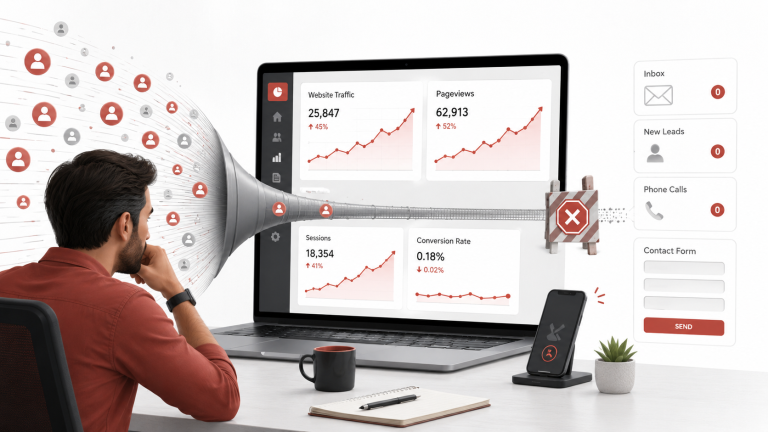
You’re checking your analytics, and the numbers look great. Visitors are climbing month over month. Your blog posts are getting read. Maybe a campaign is even bringing in a steady stream of clicks.
And yet your inbox is quiet. No form submissions, no calls, no new business.
If that sounds familiar, you’re running into one of the most common and frustrating problems in digital marketing: a traffic-rich, lead-poor website. The good news is that this is almost always fixable, because it usually comes down to a handful of identifiable issues rather than some mysterious failure. Here are the most likely culprits, and what to do about each one.
You’re attracting the wrong visitors
Traffic is only useful if it’s the right traffic. A blog post that ranks for a broad, popular keyword might pull in thousands of readers who have no intention of ever buying what you sell. They came for the answer to a quick question, got it, and left.
This is especially common when content is built around high-volume informational searches instead of terms that signal buying intent. Someone searching “what is content marketing” is in a very different mindset than someone searching “content marketing agency for SaaS.”
What to do: Look at which pages drive your traffic and ask whether those visitors actually match your ideal customer. Shift some of your content strategy toward intent-driven topics, the kind of searches people make when they’re closer to a decision.

Your offer isn’t clear within seconds
Most visitors decide whether to stay or leave within the first few seconds of landing on a page. If they can’t immediately tell what you do, who it’s for, and why it matters to them, they bounce, no matter how good your underlying service is.
Vague headlines are a frequent offender. “Innovative solutions for modern businesses” tells a visitor nothing. A clear, specific value proposition tells them exactly what they’ll get.
What to do: Read your homepage headline out loud. Could a stranger explain what you offer after reading just that line and the subhead? If not, rewrite it to be concrete and benefit-focused.

There’s no obvious next step
A surprising number of websites forget to ask. Visitors read a great page, feel interested, and then find nothing telling them what to do next. No button, no form, no clear path forward.
Calls to action that are buried at the bottom of a page, written in weak language (“Learn more”), or competing with five other links all dilute the chance that someone takes action.
What to do: Give every important page one primary, visible call to action. Make it specific (“Get a free quote,” “Book a 15-minute call”) and repeat it logically as the visitor scrolls.
You’re asking for too much, too soon
The opposite problem also exists. Sometimes the call to action is clear, but it asks for a level of commitment the visitor isn’t ready to give. A first-time visitor who just discovered you is rarely ready to “Schedule a paid consultation.” A long contact form with ten required fields will scare off people who would happily have given you their email.
What to do: Match the size of the ask to where the visitor is in their journey. Offer a low-friction entry point, such as a downloadable guide, a free checklist, or a short newsletter, that lets people raise their hand without committing to a big decision.
Friction is quietly killing conversions
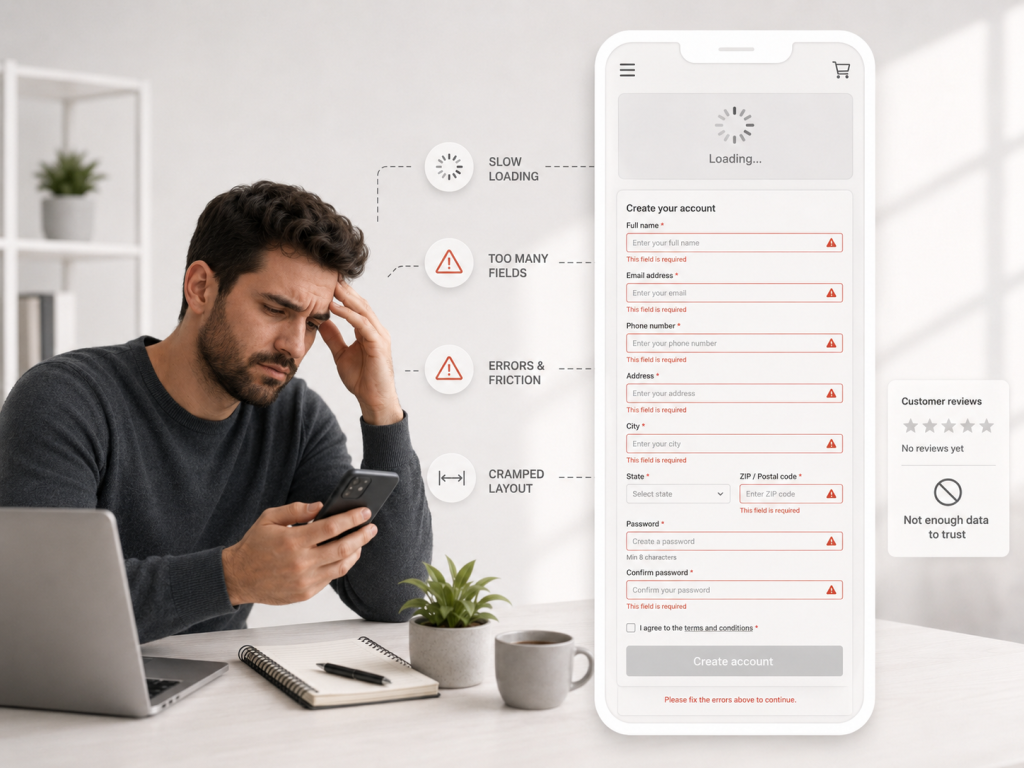
Even motivated visitors will give up if the path to conversion is annoying. Slow load times, forms that break on mobile, pages that aren’t optimized for phones, or a checkout-style flow with too many steps all chip away at your results.
Because this friction is invisible in your traffic numbers, it often goes unnoticed for a long time. People are arriving; they’re just hitting walls you can’t see from a dashboard.
What to do: Test your site the way a real visitor would, especially on a phone. Try to fill out your own forms. Check your page speed. Each small obstacle you remove tends to recover a few more leads.
There’s no trust on the page
People don’t hand over their contact information to a business they don’t trust. If your site lacks the signals that reassure visitors, such as testimonials, reviews, recognizable client logos, case studies, or even a clear “About” page with real faces, then a hesitant visitor has no reason to leap.
What to do: Add proof near your calls to action. A single relevant testimonial next to a contact form can do more for conversions than another paragraph of copy describing your services.
You’re not capturing the people who aren’t ready yet
Most visitors won’t convert on their first visit, and that’s normal. The mistake is treating that first visit as your only chance. Without a way to stay in touch, those near-misses are gone for good.
What to do: Build in ways to keep the conversation going, such as an email list, a retargeting campaign, or genuinely useful content people want to follow. A lead that isn’t ready today may convert in three months if you stay on their radar.
Putting it together
When a website gets traffic but no leads, the instinct is often to chase more traffic. Usually, that’s the wrong move. If your site converts poorly, sending more visitors to it means more wasted clicks. The higher-leverage work is fixing what happens after people arrive.
Start by auditing one thing at a time: Are these the right visitors? Is the offer clear? Is there an obvious, appropriately sized next step? Is the path frictionless and trustworthy? More often than not, the leads were within reach all along, blocked by a few quiet problems that are very fixable once you know where to look.
If you’d like a second set of eyes, a conversion-focused audit can usually pinpoint exactly where your leads are slipping away, and what to fix first.